
Welcome to
the Tarpon Springs
Leadership Conservatory
for the Arts
The Tarpon Springs Leadership Conservatory for the Arts program provides a world-class learning center of excellence that integrates leadership skills, the performing arts, and advanced technology with a rigorous academic curriculum. We provide a learning environment that prepares today’s students for the shift to tomorrow’s challenges, which shapes and builds their creative ability to adapt to the changing world while being the best version of themselves.
A child’s secondary education provides the foundation for the rest of his or her life. We want to encourage you to take a look at this unique educational opportunity and what the Leadership Conservatory for the Arts has to offer your student. We have designed the Leadership and Performing Arts curriculum to include something for everyone whether they play an instrument or not.
When Kevin Ford came to Tarpon Springs High School in Pinellas County Florida over 25 years ago, he vowed to build a band program. Seven students surfaced for the first practice, and it was then that Mr. Ford knew the only way to build this program would be through an unwavering commitment to excellence. As the band and the music program at Tarpon Springs High School grew, so did Mr. Ford’s vision. He envisioned a comprehensive music program that would not only produce top musicians, but also yield outstanding citizens. This became the blueprint for what would become the Tarpon Springs Leadership Conservatory for the Arts, a leadership program that would focus on the development of the whole student; in the classroom, in the music room and as a leader in the community. Mr. Ford’s vision became a reality when the Conservatory was designated a magnet program in 2008. “The primary goal of the program is for each student to become more self-confident, to develop strong personal discipline, organizational and leadership skills, to succeed academically, and to learn to serve by helping others,” said Mr. Ford. By 2014, his seven-member band had expanded into a world-class, 300 member performing arts program whose accomplishments include the following:
- Magnet students have performed at Carnegie Hall, the Kennedy Center and at such prestigious events as the Savannah Jazz Festival and the Smoky Mountain Music Festival.
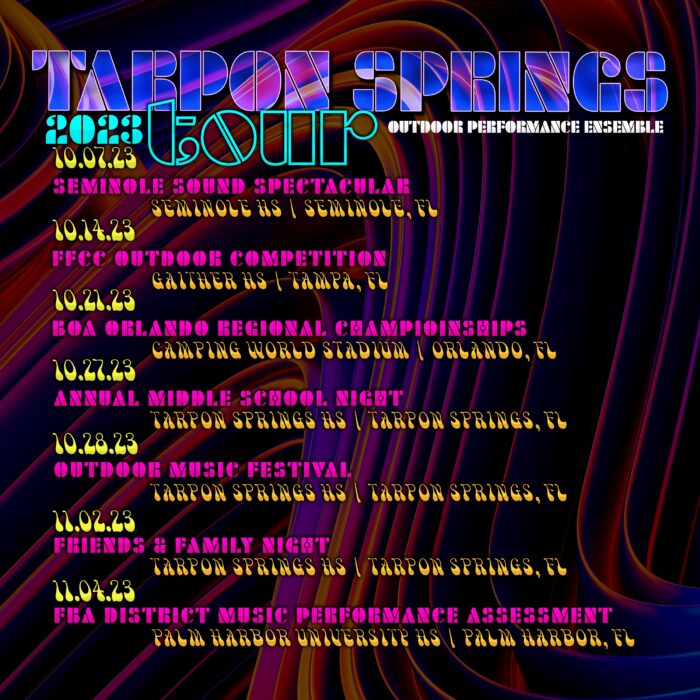
- Under Mr. Ford’s direction, the Tarpon Springs Outdoor Performance Ensemble has been named a seven-time Bands of America AA and AAA division Super Regional Champion and BOA Grand National Champion in 2014.
- The band was one of 11 bands from around the country to perform at the 2013 Macy’s Thanksgiving Day Parade in New York City.
- In 2016, the band was named the recipient of the National Band Association’s Program of Excellence Blue Ribbon Award. A highly honored national award that recognizes programs and educators which challenge students and promotes standards of excellence.
- The band has been invited to perform again at the Macy’s Thanksgiving Day Parade in New York City in 2022.
Mr. Ford’s life has been decorated with numerous achievements and the City of Tarpon Springs has dedicated a day in his honor for contributions to the school and its students.
The Tarpon Springs High School Leadership Conservatory for the Arts is dedicated to providing an outstanding artistic experience, rigorous academics, integrated technology experiences, and a leadership curriculum that develops each individual’s character and ability for leadership.
Through the study and performance of the highest quality musical literature, the Conservatory program allows individuals to develop musical artistry, poise, confidence, and self-discipline. They develop an understanding and love for the art of music and dance and the process for success in every aspect of their lives.
The Conservatory membership reflects the cultural and economic diversity in our community, brought together in a joyful, caring, and supportive environment.
We are proud to be a countywide magnet program within the Pinellas County School system which is open to all students who have the desire to develop their ability to be a leader and become the best student performers they can possibly be. Admittance is subject to current school assignment and magnet program procedures .
Our program offers a learning center where the students develop into life-long learners and leaders. We help shape and build their creative ability to adapt to our changing world.
Our arts curriculum teaches students the skills of analysis and synthesis. We encourage them to cross boundaries and guide them with creativity and imagination to be the most they can be.
Our program provides a strong creative learning environment that prepares today’s digital student for the global world of technology and problem solving.
Our program showcases community partners from the private and public sector that provide mentoring and real world experiences that show our students how their dreams of today can become their reality of tomorrow.
Featured Event
Donate
Affiliations
-

- All American Marching Band
-

- WGI Sport of the Arts
-

- Pinellas County Schools
-

- National Band Association
-
- Macy’s Thanksgiving Day Parade
-
- fname
-

- Florida Federation of Colorguard Circuit
-

- Florida Bandmasters Association
-

- Essentially Ellington
-

- D’Addario
-

- Bands of America
